

For a Miami business coach selling a $5K–$50K engagement, a missed call is rarely a missed call — it’s a lost client. A founder who dials your number at 8:40pm after a brutal board meeting, gets voicemail, and hangs up doesn’t try again tomorrow. He calls the next coach on his list. The inquiry you paid an ad platform to generate evaporates in the four rings it takes to reach your voicemail greeting. This post is about that leak — why coaches are structurally bad at answering the phone, what each unanswered call actually costs a high-ticket practice, and how a 24/7 AI receptionist built in GoHighLevel (GHL) closes the gap by answering, qualifying, and booking the discovery call while you’re mid-session or asleep.
The missed-call problem no coach wants to admit
Ask most coaches how they get clients and they’ll talk about their content, their funnel, their referral network. Ask them how many inbound calls they missed last week and you’ll get a blank look — because nobody tracks the call that never connected. It leaves no trace. There’s no “missed lead” line item, no notification that says a person who was ready to hire you just gave up. The leak is invisible, which is precisely why it’s so expensive.
Here’s the uncomfortable reality. When researchers placed calls to a sample of small businesses, only 37.8% were answered by a live person — an identical 37.8% went to voicemail, and 24.3% got no answer at all (411 Locals study of 85 U.S. small businesses, data collected ~2013–2015). That study is old and small, so don’t treat “62% unanswered” as a fresh 2026 law of nature. But every coach who has ever let a call ring out while finishing a session knows the direction is right: a large share of the people who try to reach you don’t.
Where inbound calls to small businesses landed in a sample audit (percent of calls). Source: 411 Locals study of 85 U.S. small businesses (data ~2013–2015; illustrative of the pattern, not a current national figure).
The problem isn’t that coaches are lazy. It’s that the job of coaching is fundamentally incompatible with being available to answer a phone. And for a practice built on high-ticket, high-trust engagements, the cost of that incompatibility is brutal.
Why coaches miss more calls than most businesses
A retail store has a person behind the counter. A law firm has a receptionist. A solo or boutique coaching practice has you — and you are, by design, unreachable for most of the working day. The structural reasons coaches miss calls:
- You’re in session. The core billable activity — coaching — is a phone-off, do-not-disturb block. Every hour you’re most valuable is an hour you cannot answer a new inquiry.
- Your buyers call at strange hours. Executives and founders, your highest-ticket prospects, do their “I need help” reflection in the evenings and on weekends, after the workday that created the problem. That’s exactly when a solo coach is off the clock.
- You’re one person, one line. There’s no overflow. If you’re on a call, the next caller gets voicemail — and, as the research above shows, voicemail is where inquiries go to die.
- You confuse “I’ll call them back” with responsiveness. By the time you’re out of session, hours have passed. The moment of resolve that made them dial is gone.
None of this is a character flaw. It’s a coverage gap — and coverage gaps are exactly what automation is built to close. The same logic drives our speed-to-lead system for coaches: the fix isn’t to work harder at answering, it’s to make sure a fast, on-brand response happens without you.
The real cost of a missed call for a high-ticket practice
For a business selling a $40 haircut, a missed call is an annoyance. For a coach selling a $12,000 program, a single missed call can be the most expensive event of the month. Do the math on your own numbers and it gets uncomfortable fast: if one in ten inquiry calls turns into a client, and your engagement is worth five figures, then every ten missed calls is a five-figure hole you never see on a report.
Three research-backed reasons the cost is higher than coaches assume:
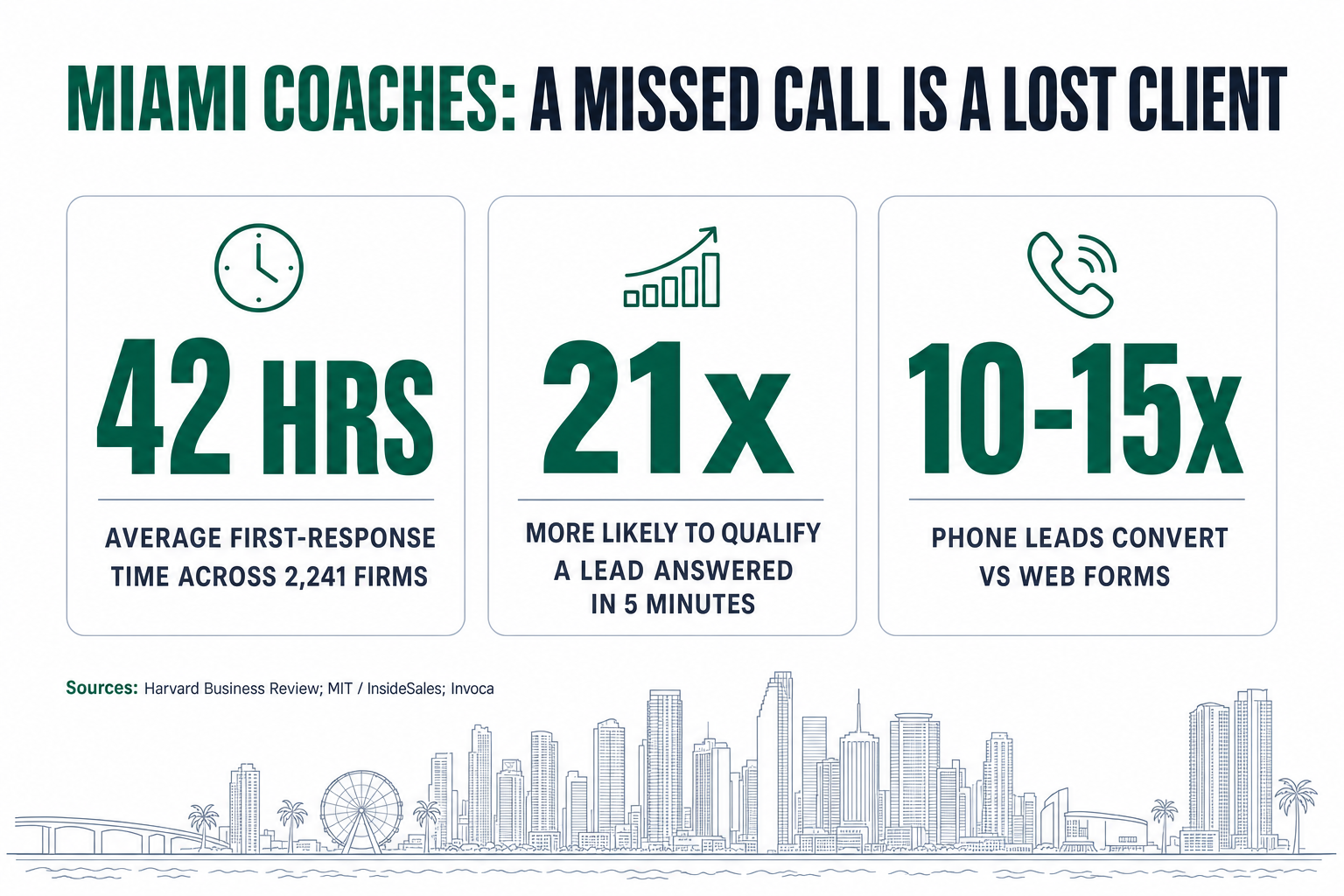
First, the phone is your best channel — not your backup one. Phone leads convert to revenue at roughly 10–15× the rate of web-form leads, and 84% of marketers report that calls drive higher conversion rates and larger order values than any other channel (Invoca). Someone willing to call a coach is signaling far more intent than someone who fills a form and waits. Miss that call and you’ve lost your most qualified prospect, not your least.
Second, they don’t wait — they replace you. A prospect deciding to hire a coach almost always has a shortlist. When your line goes to voicemail, they don’t sit on hold with your greeting; they dial the next name. And winning them back later is the expensive path: acquiring a new customer costs 5–25× more than keeping one you already had contact with, and even a 5% improvement in retention can lift profits 25–95% (Bain & Company / Harvard Business Review). Letting a warm, in-market caller walk is the single most wasteful thing a lead-generation budget can do.
Third, slow is the default, so fast is a moat. The famous Harvard Business Review audit of 2,241 U.S. companies found the average first response took 42 hours, and 23% never responded at all (HBR). The field is so slow that simply answering now — every time, on the first ring — puts you ahead of nearly everyone competing for the same client.
Why this hits Miami coaches especially hard
Miami is one of the most competitive coaching and consulting markets in the country. The city runs on relationship-driven, high-ticket professional services — real estate, hospitality, finance, health, and a fast-growing founder and executive scene across Brickell, Wynwood, Coral Gables, and Miami-Dade at large. That density is good news and bad news for a coach: there’s a deep pool of buyers who can afford a five-figure engagement, and there’s a long list of other coaches ready to answer the phone you didn’t.
Two Miami-specific pressures make the missed-call leak worse:
- A bilingual, always-on service culture. Prospects here expect to reach a business when they are free — often in the evening, often in Spanish or English interchangeably. A voicemail box that only speaks one language and only “works” 9-to-5 quietly filters out a chunk of your market.
- Seasonality and events compress demand. From Art Basel to peak winter season, Miami’s calendar bunches high-intent inquiries into windows when you’re most likely to be booked solid — exactly when you can least afford to let a call ring out.
A 24/7 AI receptionist neutralizes both. It answers on the first ring, at any hour, in the caller’s language, and never once tells a Miami founder to “leave a message after the tone.” For a local practice, that’s not a nice-to-have — it’s how you stop feeding your ad spend to the competitor down the street. If your website is also slow or hard to book on, pair this with a fast, conversion-ready coaching site so the click-to-call and the calendar actually work when demand spikes.
Speed is the whole game — and voicemail isn’t speed
The foundational research on lead response is unambiguous. The Lead Response Management study led by Dr. James Oldroyd at MIT (with InsideSales.com) analyzed roughly 15,000 leads and 100,000 call attempts and found that contacting a web lead within 5 minutes versus 30 minutes makes you about 100× more likely to make contact and 21× more likely to qualify the lead (Lead Response Management study). The decay curve is steep — most of the value is gone within the first half hour.
Relative odds of qualifying an inbound lead by first-contact speed (30-minute reply = baseline 1×). Source: MIT / InsideSales Lead Response Management study.
Here’s the part coaches miss: voicemail is not a fast response — it’s a slow one dressed up as a courtesy. When a caller hits your voicemail, the clock doesn’t pause politely; it keeps running while the lead cools. Buyers know this, which is why so few bother to leave a message at all. And their patience is shrinking: BrightLocal’s 2025 consumer research shows a growing share of people now expect a same-day or next-day response from local businesses, up sharply year over year (BrightLocal Local Consumer Review Survey 2025). “I’ll call you back after my 4 o’clock” is, to a modern buyer, indistinguishable from “no.”
The only way a solo or boutique coach hits a five-minute response standard around the clock is to remove the human bottleneck from the first touch. That’s the entire premise of an AI receptionist.
What a 24/7 AI receptionist actually does
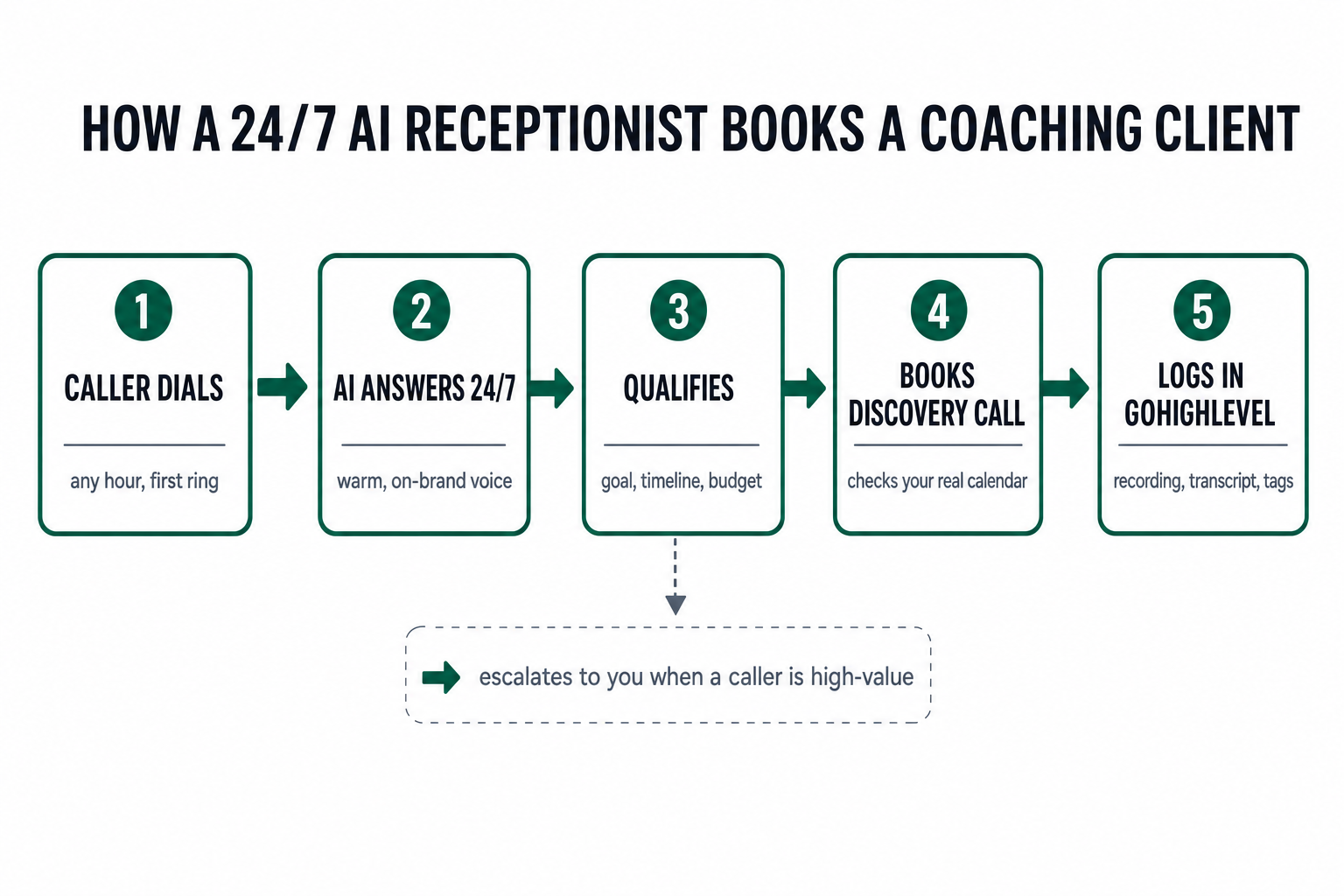
An AI receptionist is not a robocall menu (“press 1 for sales”). It’s a conversational voice agent that answers your business line like a trained front-desk person would — except it never sleeps, never double-books, and never lets a call ring out. For a coaching practice, a well-built one does five jobs:
- Answers on the first ring, 24/7. No voicemail, no hold music, no after-hours gap. Every caller reaches a warm, on-brand voice immediately.
- Qualifies the caller. It asks the same intake questions you’d ask — what they’re working on, their timeline, their budget range — the way your best application form does, but conversationally, on the phone.
- Books the discovery call. It checks your real calendar and offers open slots, so the caller books before they hang up — the single most valuable action in a high-ticket funnel.
- Logs everything in your CRM. The call is recorded, transcribed, tagged, and dropped into your GoHighLevel pipeline with the qualification notes attached, so nothing lives in a voicemail you’ll forget to check.
- Escalates when it matters. If a caller is high-value or asks something the agent shouldn’t answer, it can text you instantly or warm-transfer — so a human enters exactly when a human is needed.
This isn’t fringe technology anymore. The broader conversational-AI market is projected to grow from $11.58 billion in 2024 to $41.39 billion by 2030 (a 23.7% CAGR), per Grand View Research, and the voice-specific segment is growing even faster — one analysis pegs voice AI agents at a 34.8% CAGR through 2034 (Market.us). The tools are mature; the coaches who deploy them early get the answered calls their competitors are still sending to voicemail.
A Tuesday, 8:40pm, mid-session
A founder calls after a hard board meeting. Four rings, then your voicemail. He doesn't leave a message. He calls the next coach on his list. You never know the call happened — no lead, no trace, no second chance.
The same founder calls. The agent answers on the first ring, asks what he's working on and his timeline, offers Thursday at 10am, and books it. By the time you're out of session, there's a qualified discovery call on your calendar with notes attached.
How to build an AI receptionist in GoHighLevel
The good news for coaches already on GHL: the receptionist doesn’t live in a separate silo. It plugs into the CRM, calendar, and workflows you already use. At a high level, the build is:
- Provision the voice agent. A production voice-AI layer (built on platforms like VAPI or Retell) answers your business number with a script tuned to your practice and offer — not a generic “how can I help you.”
- Give it your qualification logic. Feed it the same criteria your discovery-call funnel uses so it screens for fit, not just volume — the phone equivalent of a well-built application form.
- Connect it to your calendar. The agent reads real availability from your GHL calendar and books directly, then fires your existing appointment and reminder automation so the booked call doesn’t become a no-show.
- Bridge every call into GHL. Recording, transcript, tags, and pipeline stage flow into the contact record automatically, with urgency triggers and live-transfer rules for high-value callers.
- Add the SMS safety net. If a call drops or comes in while the agent is mid-conversation, an instant SMS follow-up keeps the thread warm — text lands at roughly a 98% open rate versus about 20% for email (Gartner).
This is exactly the kind of custom voice-AI-to-GHL pipeline our team builds — recording, transcribing, and tagging every inbound discovery call inside GoHighLevel, with the qualification and booking logic tuned to how you actually coach. You can wire the pieces yourself if you enjoy the build, or have it delivered done-for-you.
Automation that protects the relationship, not replaces you
The obvious objection: isn’t answering a coaching inquiry with AI cold? It would be — if the AI tried to be the coach. It doesn’t. The AI receptionist handles the part of the interaction that was never relational to begin with: the logistics of getting a qualified human onto your calendar. The moment there’s a real conversation to have — the discovery call, the coaching itself — that’s you, fully present, with the context already gathered.
Think about what the alternative actually communicates. A prospect who reaches your voicemail at 9pm doesn’t experience “warmth” — they experience being ignored. An agent that answers, listens, and books them a slot experiences as attentiveness: someone (or something) took them seriously the instant they reached out. Done well, automation at the front door doesn’t cheapen the relationship. It makes sure the relationship gets to start at all. The same principle runs through our whole approach — from reducing discovery-call no-shows to accountability check-ins that don’t feel creepy: protect the human moments by automating everything that isn’t one.
For a Miami coach competing in a crowded, fast-moving market, the math is simple. Your prospects are calling. Slow is the industry default. The coach who answers first — every time, at every hour — is usually the coach who gets the call. An AI receptionist is how a one-person practice finally answers like a ten-person firm.
FAQ
What is an AI receptionist for a coaching business?
An AI receptionist is a conversational voice agent that answers your business phone line 24/7 — like a trained front-desk person, but one that never sleeps or double-books. For a coach, it answers on the first ring, asks your intake and qualification questions conversationally, checks your real calendar and books the discovery call, and logs the recording, transcript, and notes into your GoHighLevel CRM. It handles the logistics of getting a qualified prospect onto your calendar so you can stay in session — and it escalates or texts you when a caller is high-value or needs a human.
How much does a missed call really cost a high-ticket coach?
More than most coaches think. Phone leads convert to revenue at roughly 10–15 times the rate of web-form leads, and 84% of marketers say calls produce higher conversion and larger deals than other channels (Invoca). So a missed call is usually your most qualified prospect walking, not your least. Because the average first response across companies takes 42 hours and 23% never respond at all (HBR), and because winning a lost prospect back costs 5–25 times more than keeping contact with them (Bain/HBR), a single unanswered call on a five-figure engagement can be the most expensive event of your month.
Why do business coaches miss so many calls?
It's structural, not a character flaw. The core billable activity — coaching — is a phone-off, do-not-disturb block, so the hours you're most valuable are the hours you can't answer. Your highest-ticket buyers (founders and executives) tend to call in the evenings and on weekends when a solo coach is off the clock, and a one-person practice has no overflow line, so the next caller gets voicemail. Since only about a third of calls to small businesses reach a live person in sample audits (411 Locals), a lot of warm inquiries never connect.
Is an AI receptionist worth it for a Miami coaching practice specifically?
Miami is a dense, competitive, high-ticket services market with a bilingual, always-on service culture and seasonal demand spikes (peak winter season, major events) that bunch inquiries into windows when you're most likely to be booked solid. A 24/7 AI receptionist answers on the first ring in the caller's language at any hour — so you stop feeding your ad spend to the competitor who did answer. In a market where buyers have a long shortlist of coaches, answering first is often how you get the call.
Will an AI receptionist make my coaching practice feel impersonal?
Only if it tries to be the coach — which it shouldn't. A well-built agent handles the part of the interaction that was never relational: the logistics of getting a qualified human onto your calendar. The real conversation — the discovery call and the coaching itself — is still you, with the context already gathered. In practice, a prospect who reaches voicemail at 9pm feels ignored, while one the agent answers and books feels taken seriously the instant they reached out. Automation at the front door protects the relationship by making sure it gets to start at all.
Can I build an AI receptionist inside GoHighLevel?
Yes. A production voice-AI layer (built on platforms like VAPI or Retell) answers your number with a coaching-specific script, uses your qualification logic to screen for fit, reads availability from your GHL calendar to book directly, and bridges every call — recording, transcript, tags, pipeline stage — into your GoHighLevel contact record with live-transfer rules for high-value callers. It connects to your existing appointment reminders and an SMS safety net so booked calls don't become no-shows. You can build it yourself or have it delivered done-for-you as a custom GHL development project.
Related reading
- Speed to Lead for Coaches — the instant-response system every inbound inquiry should hit, on every channel.
- How to Reduce Discovery-Call No-Shows — once the AI books the call, keep it from evaporating.
- The Coaching Application Form That Actually Qualifies — the qualification logic your AI receptionist should ask on the phone.
- Build a Coaching CRM Sales Pipeline That Closes — where every answered, qualified call should flow next.
- AI for Business Coaches — where an AI receptionist fits in the wider stack of coaching automation.
About the author. Tara Iyengar is a Funnel & Client-Experience Designer based in Raleigh, NC, who designs the client-facing surface of coaching practices — intake and application forms, first-contact flows, and the SMS cadences clients actually thank you for. She is opinionated about message timing and allergic to “just checking in” texts.
Outcomes described on this site are illustrative, not guaranteed. The statistics cited are drawn from third-party research linked inline; some figures (notably the 411 Locals call-answer sample) are older or from limited samples and are noted as such. Your results depend on your offer, lead sources, and market.